

Views: 0 Author: Site Editor Publish Time: 2026-07-07 Origin: Site


Unmanaged hydrostatic pressure silently destroys structural foundations every day. Soil migration frequently causes retaining wall collapses and failed French drains across both residential and commercial job sites. The stakes of your material selection could not be higher. Substituting engineering-grade geotextiles with cheap landscape weed barriers directly causes system clogging. It leads to costly excavations and massive structural liabilities down the line. You need absolute confidence in the barrier protecting your underground systems. We created this guide to provide a clear, spec-driven framework for evaluating and procuring a reliable drain geotextile. You will learn about core filtration mechanics, necessary strength requirements, and harsh installation realities. Ultimately, this knowledge ensures your next earthwork project remains stable, functional, and deeply protected against premature subterranean failure.
Material matters: Always specify nonwoven (needle-punched) over woven fabrics for subsurface drainage to ensure proper water flow without soil blinding.
The 6 oz sweet spot: A 6 oz weight offers the optimal balance of high survivability (tear resistance during aggregate backfill) and adequate permittivity (water flow).
Critical specs: Procurement decisions should be based on Grab Tensile Strength, Apparent Opening Size (AOS), and Water Flow Rate (GPM), not just price per roll.
Installation dictates performance: Even premium drainage trench fabric will fail if overlap minimums (12–18 inches) and aggregate drop-height limits are ignored.
Understanding the fundamental difference between manufacturing processes dictates the success of your application. Woven fabrics typically use a slit-film process. Manufacturers extrude plastic sheets, slice them into flat tapes, and weave them tightly together. This creates an incredibly rigid material. Conversely, manufacturers create nonwoven fabrics through a needle-punching method. They take millions of short staple fibers and repeatedly punch them using barbed needles. This process tangles the fibers into a thick, permeable, felt-like layer.
You must understand why woven materials consistently fail in drainage applications. Woven textiles prioritize high tensile strength for soil stabilization. They stretch very little under heavy loads. However, their tight weaves lack the high permittivity required for active drainage. Water cannot pass through fast enough. Fine silts quickly pack into the few available surface openings. This blocks water passage entirely and leads to immediate system clogging.
Here are three reasons why the needle-punched advantage dominates subsurface water management:
Three-dimensional flow: The tangled fibers create a complex 3D filtration matrix. Water passes through freely from multiple angles.
Superior trapping: A nonwoven drainage fabric traps fine soil particles within its depth, rather than letting them block the surface.
Maintained permittivity: Even when partially loaded with sediment, the material retains enough open channels to move water efficiently.
You might wonder why a 6 oz weight is the industry standard. Lighter 3-ounce or 4-ounce fabrics tear easily during installation. Heavy angular gravel routinely punches holes straight through thin materials. Heavier 8-ounce or 10-ounce fabrics offer extreme puncture resistance but restrict water flow significantly. The 6 oz profile hits the perfect heavy-duty sweet spot. It resists tearing from sharp rocks while maintaining more than enough water flow for heavy-load project areas.
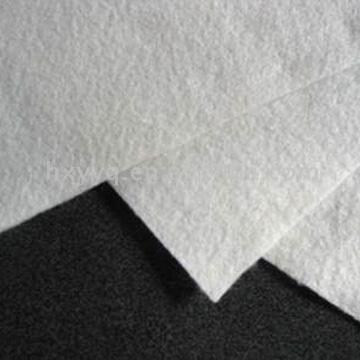
Evaluating civil engineering fabrics requires looking past marketing labels. You must scrutinize specific technical metrics. Relying on concrete Key Performance Indicators (KPIs) protects your structural builds from premature failure.
The Apparent Opening Size (AOS) determines how well the fabric filters soil. We measure AOS using US Sieve numbers. You typically want an AOS between US Sieve #70 and #100 for drainage. You must match the AOS to your native soil type. Sandy soils require different filtration sizes than heavy clay soils. If the pores are too small for clay environments, fine particles create an impenetrable crust. Engineers call this phenomenon "blinding." It ruins pore functionality completely.
Water Flow Rate, or permittivity, dictates system capacity. Set your baseline expectations high. A reliable filtration fabric should exceed 100 Gallons Per Minute (GPM) per square foot. This ensures the barrier handles peak storm runoff seamlessly. Slow flow rates cause water to pool aggressively behind your retaining walls. Accumulated hydrostatic pressure easily snaps heavy timber and dislodges concrete blocks.
Grab Tensile and Puncture Strength act as your ultimate survivability metrics. You rarely damage fabrics after you bury them. The real danger happens during installation. Excavators drop massive loads of angular aggregate directly into open trenches. The fabric must withstand these brutal impacts. High puncture strength prevents micro-tearing. Even tiny tears allow silt to invade and ruin the pristine aggregate core.
UV Resistance remains critical despite the subterranean nature of these materials. You use these fabrics underground, but construction delays happen frequently. Rolls often sit exposed to harsh sunlight for weeks. UV radiation severely degrades raw polypropylene. Quality materials boast high UV resistance metrics, such as retaining 70% of their structural strength after 500 hours of direct sunlight exposure.
Standard KPI Baseline for 6 oz Drainage Materials | ||
Performance Metric | Recommended Baseline | Primary Purpose |
|---|---|---|
Apparent Opening Size (AOS) | US Sieve #70 to #100 | Prevents soil blinding and clogging. |
Water Flow Rate (Permittivity) | > 100 GPM/sq. ft. | Manages peak storm water runoff rapidly. |
Grab Tensile Strength | > 160 lbs | Prevents tearing during trench stretching. |
CBR Puncture Strength | > 400 lbs | Survives sharp angular stone backfills. |
Different earthwork structures demand specific deployment strategies. You must adapt your installation methods to fit the structural goals of your specific build.
Retaining walls serve two critical functions: soil separation and lateral pressure relief. Water acts as the primary enemy of any block or timber wall. You must create a dedicated drainage column directly behind the structure. You deploy the fabric by wrapping the drainage stone completely. This separates your native backfill dirt from your clean drainage gravel.
Sourcing the right retaining wall geotextile prevents fine silt from washing through the block face. Without this barrier, muddy water stains the aesthetic front of your wall. More importantly, it stops mud from permanently clogging the vital weep holes located at the base. Once weep holes plug, hydrostatic pressure builds rapidly until the wall physically bursts outward.
French drains manage subsurface water through an encapsulated "burrito wrap" system. This technique requires meticulous attention to detail. You must fully line the trench sides and bottom before adding any pipe or stone. The fabric must enclose the entire system completely. If you leave the top open, topsoil easily washes down and ruins the clean aggregate.
Using a heavy-duty 6 oz geotextile for drain encapsulation ensures massive longevity. This proves especially vital in high-traffic or deep-trench commercial deployments. The thick 6 oz material easily bridges minor uneven gaps in rough trench cuts. It provides a durable shell that keeps the inner perforated pipe safe from encroaching tree roots and migrating clay deposits.
Buying premium material solves only half the problem. Poor installation techniques routinely destroy expensive materials. You must avoid these common field mistakes to guarantee a permanent fix.
Contractors often fall victim to the "upside-down" myth. Many workers believe the fabric has a specific "up" or "down" side based on its fuzzy texture. In reality, needle-punched nonwovens are generally multi-directional. Water flows equally well through both sides. Always verify the manufacturer spec sheets, but you usually do not need to worry about directional placement.
Inadequate overlap ranks as the leading cause of structural soil intrusion. Seams represent the weakest point in any trench system. You must enforce strict 12-inch to 18-inch overlap minimums. Always overlap the seams in a shingle-style pattern relative to the water flow direction. This ensures gravity carries water over the seam, rather than driving it underneath the flap.
Backfill damage happens quickly and quietly. Do not let machine operators drop heavy, sharp aggregate directly onto unprotected fabric from high elevations. Dropping #57 stone from three feet up will puncture even premium materials. Lower the excavator bucket as close to the trench floor as possible before releasing the stone. Alternatively, place the first lift of stone carefully by hand.
Trench tension destroys materials during the backfilling phase. You must intentionally leave slack in the fabric when placing it inside a trench. Form the material into a loose "U" shape inside the cut. If you pull the fabric tight across the trench walls, the heavy stone will violently stretch and tear the material as it settles downward. Give the fabric room to conform to the trench contours safely.
Sourcing reliable materials requires strict discipline. The market floods buyers with deceptive marketing terms. You must navigate supplier catalogs using engineering standards rather than flashy packaging.
Beware of "Landscape Fabric" labels: Never buy consumer-grade garden fabrics masquerading as structural material. These thin, woven plastics block weeds in garden beds. They degrade quickly and suffocate water flow. You need an engineered drainage trench fabric built for civil applications.
Look for NTPEP/AASHTO compliance: Demand technical proof from your suppliers. Request the manufacturer Specification Data Sheets (SDS). Verify the material meets accepted civil engineering standards. Look specifically for AASHTO M288 Class 2 or Class 3 certifications. This guarantees the material passed rigorous third-party testing.
Calculate roll dimensions and job site scaling accurately: Do not just buy the exact linear footage of your trench. You must factor in a 15% waste and overlap buffer. Wrapping the burrito system requires significant extra material. Account for corners, overlaps, and trench depth when scaling your bulk orders.
Verify environmental and compliance signals: Reputable brands operate transparently. They clearly state their material composition on the technical sheets. Look for materials made from 100% virgin polypropylene. Virgin plastics resist biological and chemical degradation in harsh, acidic soil environments far better than recycled polymer blends.
Choosing a reliable 6 oz nonwoven geotextile acts as your ultimate insurance policy against premature earthwork failure. Structural integrity relies entirely on keeping native soils out of clean drainage zones. Woven materials and cheap landscape barriers simply cannot handle the fluid dynamics required for these systems.
Prioritize specific engineering metrics over marginal cost savings. Base your final procurement choices on Apparent Opening Size, Water Flow Rate, and Puncture Strength. Saving a few dollars on thinner rolls will cost you thousands in future excavation and repair bills when the wall inevitably fails.
Take action on your project today. Measure your total linear trench or wall footage accurately. Calculate your 15% overlap requirements to determine your true material needs. Finally, reach out to your shortlisted civil supply brands and request their official technical spec sheets. Comparing these documents side-by-side guarantees you secure the right protective barrier for your exact terrain.
A: No. Woven fabrics will clog with silt over time, blocking water flow and causing the drain to fail. Always use nonwoven.
A: When properly installed and kept out of direct UV light, high-quality polypropylene geotextiles can last 50+ years, resisting rot, mildew, and soil chemicals.
A: No. While thicker than 4 oz, a 6 oz nonwoven fabric still typically allows over 100 gallons per minute per square foot, which exceeds the requirements for almost all residential and commercial retaining walls.
A: Landscape fabric is designed primarily to block weeds and degrade over time. Filter fabric (geotextile) is engineered for structural soil separation, high-volume water filtration, and permanent durability.


