

Views: 0 Author: Site Editor Publish Time: 2026-07-12 Origin: Site


Slope erosion, soil degradation, and hydrostatic pressure failures heavily impact civil engineering projects worldwide. These common issues frequently lead to catastrophic project delays. They also demand intense, ongoing structural maintenance. Traditional grading methods often struggle against heavy rainfall and severe runoff. The HDPE perforated geocell provides a precise engineered intervention designed specifically for these severe conditions. It securely holds diverse infill materials in place, even on highly demanding steep grades. Engineers use it to lock topsoil or aggregate firmly into a resilient, immovable matrix. This article serves as an evaluation guide for civil engineers, contractors, and project managers. You will discover how to determine if this robust cellular confinement system aligns properly to your specific site requirements. We explore critical soil mechanics, strict project compliance standards, and essential material specifications. You need these technical insights to guarantee long-term slope stability and ultimate project success.
Core Function: Perforated geocells prevent slope failure by confining infill material, distributing downward forces, and actively managing subsurface water flow.
The Perforation Advantage: Holes in the cell walls are not a cost-saving measure; they are engineered to relieve hydrostatic pressure, increase frictional interlock, and promote cross-cell root growth.
Evaluation Focus: Procurement decisions should prioritize seam weld strength, material virginity (high-density polyethylene), and site-specific anchor configurations over base unit cost.
Versatility: Functions effectively as a soil stabilization geocell across multiple infill types, including topsoil/vegetation, gravel, and concrete.
Civil engineers constantly battle the destructive forces of gravity and water. When you rely solely on traditional grading or basic 2D geogrids, slope washouts become a frequent reality. Rill erosion quickly strips away topsoil during heavy rain events. For example, highway embankments often suffer rapid soil loss after spring thaws. Embankment sliding causes massive structural liabilities. These failures result in severe environmental damage. They force construction teams to rebuild entire embankment sections.
Hydrostatic pressure accumulation is the silent killer of steep slopes. Trapped water builds up behind non-porous stabilization structures over time. This trapped moisture rapidly creates underground failure planes. Once the base soil reaches peak saturation, the entire mass slides downward. Unmanaged water flow systematically destroys the foundation of your grading efforts.
You must establish clear success criteria for any slope stabilization intervention. A truly successful engineered solution must deliver:
Long-term structural stability against constant gravitational pull.
Minimal post-installation maintenance requirements over decades.
Actively managed drainage to prevent sudden soil saturation.
Strict compliance regarding environmental regulations and stormwater runoff laws.
A high-quality slope protection geocell bridges the critical gap between simple surface erosion control mats and heavy retaining walls. It offers deep structural reinforcement without requiring massive concrete footings.
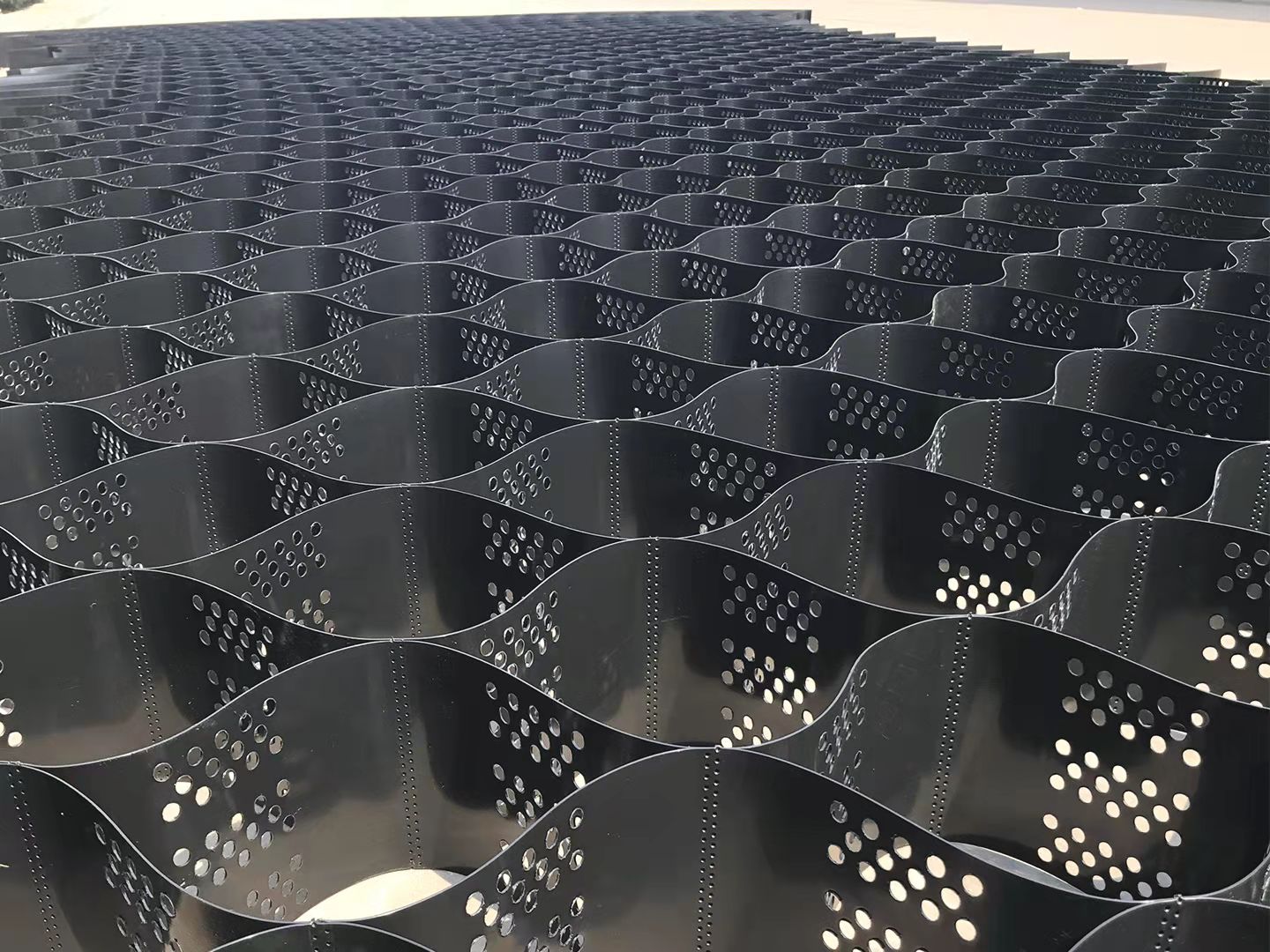
A cellular confinement system functions as a highly durable three-dimensional honeycomb structure. Manufacturers expand these interconnected polymer strips into a web of open cells. You lay this web across the prepared subgrade and fill it. The cells confine the material entirely, preventing any lateral movement.
The true engineering value lies within the perforations themselves. Many novice contractors assume holes simply reduce plastic weight. In reality, they serve three critical stabilization functions:
Drainage and Pressure Relief: Perforations allow continuous lateral drainage throughout the entire matrix. This prevents localized waterlogging. It entirely eliminates the catastrophic hydrostatic pressure buildup behind the slope face.
Root Lock-in: Vegetated slopes rely on deep, interconnected root systems. Holes facilitate horizontal root penetration across multiple cell walls. Plants create a secondary, highly resilient natural stabilization network.
Infill Friction: Textured and perforated walls dramatically increase the internal friction angle. The plastic grips the aggregate or gravel securely. This increased friction directly prevents material loss during severe weather events.
A properly deployed perforated geocell specifically outperforms unperforated alternatives in wet environments. Unperforated cells act like individual buckets, holding water until they overflow and fail. Perforated systems act like a unified, breathable structural blanket.
Procuring the right material requires rigorous attention to technical specifications. Evaluating material integrity begins by demanding virgin high-density polyethylene. True HDPE delivers exceptional chemical resistance against harsh soil environments. It offers superior UV degradation resistance for exposed sections. It also maintains thermal stability across extreme temperature fluctuations. You should aggressively warn your procurement teams against blended or low-grade recycled plastics. They inevitably turn brittle and shatter under load-bearing slope conditions.
The entire system is only as strong as its ultrasonic welds. Seam weld strength determines exact failure thresholds. If the welds snap, the entire cellular matrix unzips under the soil's immense weight. Standardized tests, such as ASTM D7161, provide baseline peel strength data. You must verify these laboratory test numbers before approving any supplier.
You also need a transparent decision framework for cell depth based on slope steepness. Deeper cells provide greater resistance against sliding forces.
Table 1: Recommended Cell Depth vs. Slope Angle Framework | |||
Slope Condition | Slope Angle (Degrees) | Recommended Cell Depth | Anchoring Requirements |
|---|---|---|---|
Shallow Slopes | Up to 30° | 50mm – 75mm | Standard J-pins, moderate spacing |
Moderate Slopes | 30° – 45° | 100mm | Increased density, longer rebar stakes |
Steep Slopes | 45° – 60°+ | 150mm – 200mm | High-density anchoring, engineered tendons |
Guide your buyers to vet every HDPE geocell supplier based purely on verifiable lab testing. Ignore flashy marketing claims. Focus strictly on standardized testing results for tensile strength and seam integrity.
Different project environments demand different infill materials. The cellular matrix adapts to various structural needs based on what you put inside it. A soil stabilization geocell restrains the fill, but the fill determines the surface function.
Below is a summary chart comparing the three primary infill strategies and their resulting operational outcomes.
Chart: Comparison of Primary Infill Strategies | ||
Infill Strategy | Primary Application | Operational Outcomes & Advantages |
|---|---|---|
Vegetated / Topsoil | Environmentally sensitive areas, aesthetic public works, highway embankments. | Holds loose soil perfectly until roots establish. Highly aesthetic. Restores natural ecological balance. |
Aggregate / Gravel | Shorelines, high water flow zones, arid regions. | Provides a heavy, highly permeable protection layer. Ideal where vegetation fails to survive. Reduces surface runoff velocity. |
Concrete | Spillways, severe flow channels, extreme erosion zones. | Replaces rigid articulated concrete blocks (ACBs). Pours easily. Offers flexible, hard-armored protection. Prevents cracking found in solid slabs. |
Vegetated infill works best for aesthetic requirements. The plastic matrix protects the seeds and loose soil from washing away. Once the roots establish, they intertwine through the perforations. This locks the entire slope permanently.
Aggregate infill is ideal for shoreline embankments subjected to moderate wave action. It acts as a heavy, permeable layer. Water flows in and out without removing the crushed stone.
Concrete infill serves extreme erosion zones. You pump concrete directly into the cells. This creates a flexible, armored mat. It easily handles severe hydraulic forces and channelized flow. It offers essential flexibility, unlike rigid concrete slabs prone to cracking.
Marketing brochures often describe these systems as effortlessly easy to install. Actual field realities present distinct engineering challenges. We must move past the simple marketing narrative and highlight actual installation risks.
Incorrect anchor spacing remains the number one cause of system sliding. Anchoring vulnerabilities destroy even the highest quality plastic. If you space J-pins or rebar stakes too far apart, the system bears too much localized stress. A common mistake involves using smooth rebar instead of ribbed stakes on loose soils. Anchor density must increase proportionally with both slope steepness and infill weight.
Trenching and crest anchoring are non-negotiable requirements. You must bury the top edge of the geocell array deeply into an anchor trench. If you skip this crucial step, surface water flows under the plastic. This rogue water actively undercuts the system, washing away the subgrade unseen.
Finally, you must address overfilling and compaction. Always overfill the cells slightly, usually between 25mm and 50mm. Natural settling and heavy rain will compact the infill over time. Overfilling guarantees the plastic cell walls remain protected from direct UV exposure and physical abrasion from maintenance equipment.
Selecting the correct confinement system requires a structured evaluation flow. First, assess the exact slope angle. Next, calculate expected water flow and surface runoff volume. Then, select the appropriate cell depth and infill material. Finally, strictly verify the supplier’s seam weld strength and long-term UV warranty coverage.
We must highlight a transparent assumption regarding these installations. The geocell system provides an exceptional confinement structure. However, overall project success relies heavily on accurate geotechnical soil analysis before you begin installation. Understanding your base subgrade is absolutely critical.
To ensure project compliance, request a comprehensive Technical Data Sheet (TDS) today. Compare the specification limits against your regional engineering standards. Consult directly with an engineering sales representative to calculate the exact anchor density required for your specific site conditions.
A: High-quality HDPE manufactured with specific carbon black additives offers extreme resistance to UV degradation. In properly maintained installations, the design life typically exceeds 50 years. This longevity heavily depends on ensuring the infill material consistently covers the plastic walls, shielding them from direct, prolonged sunlight exposure.
A: Yes, you can stabilize extreme slopes, but it requires specific engineering adjustments. You must utilize deeper cells, usually 150mm or 200mm. The installation also demands significantly denser anchoring patterns. Often, engineers integrate high-tensile retaining fascia or specialized engineered polymer tendons to secure the matrix safely.
A: In nearly all slope applications, yes. You must deploy a robust non-woven geotextile beneath the plastic matrix. This permeable fabric prevents fine subgrade soil from washing out through the bottom of the cells. Simultaneously, it allows essential groundwater to pass freely, preventing dangerous hydrostatic pressure buildup behind the slope.


