

Views: 0 Author: Site Editor Publish Time: 2026-05-05 Origin: Site


How can we protect our precious groundwater from toxic waste? Landfill liners act as the vital last line of defense against hazardous seepage. Engineers rely on hdpe geomembrane for landfill projects for unmatched durability. In this guide, you will learn about essential specifications and professional installation tips for these systems.
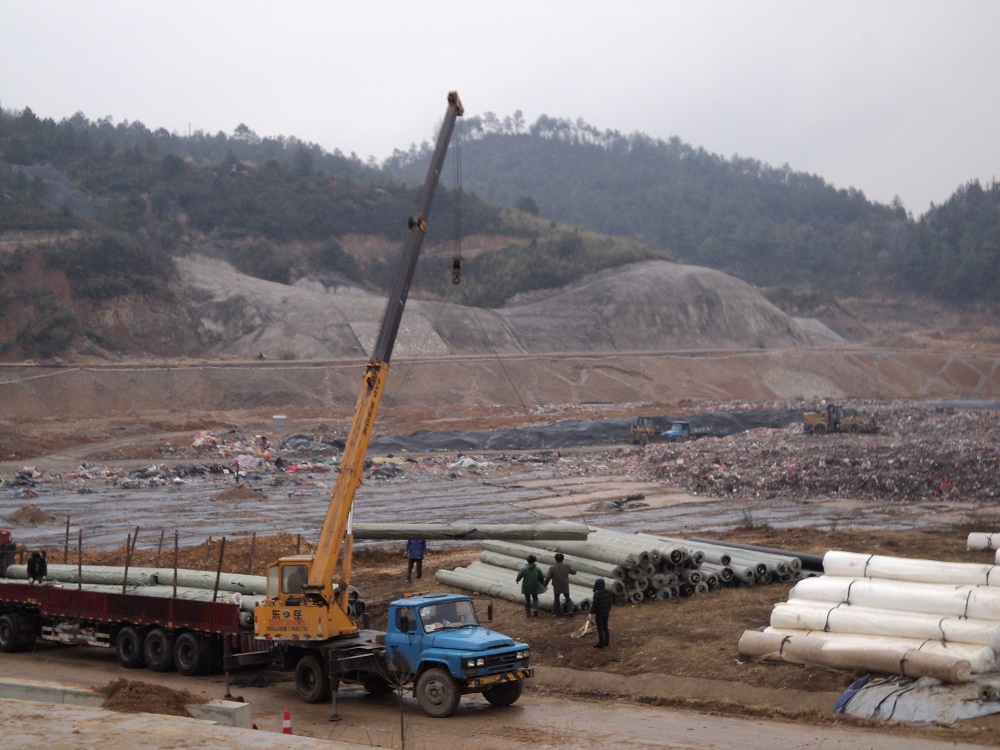
● Superior Protection: Using hdpe geomembrane for landfill liners provides an inert, impermeable barrier that prevents toxic leachate from contaminating groundwater.
● Material Standards: Industry success requires high-density resins with 2-3% carbon black and a thickness typically ranging from 1.5mm to 3.0mm for maximum puncture resistance.
● Enhanced Stability: Textured surfaces are essential for landfill side slopes to increase friction and prevent the waste mass or cover soil from sliding.
● Installation Quality: The integrity of hdpe geomembrane for landfill projects depends on advanced dual-track fusion welding and rigorous non-destructive air pressure testing.
● Economic Value: While technically advanced, these synthetic liners are more cost-effective than clay because they maximize available waste airspace and reduce long-term maintenance.
Choosing the right material for waste containment is not just about meeting regulatory minimums; it is about long-term risk management. The hdpe geomembrane for landfill applications provides a suite of physical and chemical advantages that ensure the facility remains secure for decades.
Landfill leachate is a volatile "chemical soup" containing organic acids, heavy metals, and various solvents. HDPE is naturally inert, meaning it does not react with these substances. Unlike PVC or other materials that might soften or become brittle when exposed to specific hydrocarbons, HDPE maintains its structural integrity even under constant immersion in aggressive fluids.
The primary goal of a liner is to stop liquid flow. HDPE geomembranes feature extremely low hydraulic conductivity. In practical terms, they are virtually leak-proof when installed correctly. This level of impermeability is far superior to compacted clay, which can crack over time or allow slow seepage through microscopic pores.
Landfill construction often takes months, leaving the liner exposed to direct sunlight and fluctuating temperatures. Manufacturers add specialized stabilizers to the resin, ensuring the hdpe geomembrane for landfill does not degrade under UV radiation. It remains flexible in freezing temperatures and stable in the heat, preventing the "stress cracking" that can plague lower-quality polymers.
Waste masses are heavy and prone to shifting. As the waste settles, the ground beneath the liner may experience differential settlement. HDPE can stretch significantly—often over 10% before reaching its yield point—allowing it to deform and adapt to ground movements without tearing or puncturing.
While the material cost of synthetics is a factor, they save massive amounts of money in the long run. A geomembrane is thin (usually 2mm), whereas a clay liner might need to be three feet thick. This difference saves valuable "airspace" in the landfill, allowing for more waste storage and higher revenue for the operator.
Note: Proper material selection can increase the operational life of a landfill by up to 15% simply by maximizing available vertical space.
Most global regulatory bodies, including the EPA, mandate the use of geomembranes for municipal and hazardous waste. A key reason is the reliability of the seams. Through thermal fusion welding, two panels essentially become one continuous piece of plastic. These welds are often stronger than the material itself, creating a monolithic barrier across the entire site.
Not all HDPE is created equal. For a successful hdpe geomembrane for landfill installation, engineers must specify the exact technical properties required to survive the site's unique stresses.
Property | Typical Landfill Requirement | Purpose |
Thickness | 1.5mm to 3.0mm (60-120 mil) | Puncture resistance and durability |
Carbon Black | 2.0% - 3.0% | UV protection and aging resistance |
Density | $\ge 0.941$ g/cm³ | Chemical inertness and strength |
Melt Flow Index | $< 1.0$ g/10 min | Ensures consistent welding quality |
While thin liners exist for decorative ponds, landfill projects usually start at 60 mil (1.5mm). Thicker liners, such as 80 mil or 120 mil, are common for hazardous waste cells or areas where the subgrade is less than ideal. Increased thickness provides a higher safety margin against punctures during the backfilling process.
If the landfill has steep side slopes, smooth HDPE is a liability. It is incredibly slippery. In these cases, we use textured hdpe geomembrane for landfill slopes. The texturing—created by spraying molten resin onto the sheet—increases the friction coefficient. This prevents the protective soil cover or the waste itself from sliding down the slope and tearing the liner.
The longevity of the liner depends on the "Oxidative Induction Time" (OIT). This measures how long the plastic can resist oxidation. High-quality resins mixed with 2-3% carbon black ensure the material stays "young" for decades, even when buried under tons of waste.
Tip: Always request a Manufacturer's Quality Control (MQC) report for every roll delivered to the site to verify it meets the GRI-GM13 standard.
Even the best material will fail if the installation is sloppy. High-performance containment requires a disciplined approach to field assembly.
Before the first roll of hdpe geomembrane for landfill is deployed, the ground must be perfect. We must remove all sharp stones, roots, and debris. The surface should be "smooth-drum rolled" to provide a firm, consistent base. Any standing water or soft spots must be addressed to prevent the liner from stretching unevenly.
Installation teams create a "panel map" to minimize the total length of seams. Every seam is a potential point of failure, so we aim for long, continuous runs. Panels should overlap by 10 to 15 centimeters (4-6 inches) to allow enough room for the welding equipment to pass through safely.
This is the gold standard for joining panels. A self-propelled "wedge welder" heats the overlapping edges and presses them together with rollers. It creates two parallel welds with an empty air channel in the middle. This channel is crucial because it allows us to pressure-test the entire length of the seam later.
In areas where the wedge welder cannot fit—like around pipe penetrations or at the corners of an anchor trench—we use extrusion welding. A technician applies a bead of molten HDPE over the edge of the two panels. While slower, it provides a rugged seal for the most difficult parts of the containment system.
Tip: Plan your panel deployment to run parallel to the slope (up and down) rather than across it to reduce stress on the seams.
In the world of landfill liners, we don't just hope the seams are tight—We prove it. A rigorous testing program is mandatory for every square meter of hdpe geomembrane for landfill.
For dual-track seams, we seal both ends of the air channel and inject compressed air. If the pressure holds for five minutes without dropping, we know the seam is airtight and leak-proof. It is a fast, efficient way to verify miles of welding.
We cut small "coupons" from the ends of the seams and take them to a field lab. Here, we pull them apart using a tensiometer to test "peel" and "shear" strength. The goal is for the weld to remain intact while the parent plastic breaks; this proves the bond is stronger than the sheet itself.
For extrusion welds, we use a vacuum box. We apply soapy water to the seam and place a clear-topped box over it. If bubbles appear when the vacuum is engaged, there is a leak. For the highest level of security, Electronic Leak Location (ELL) surveys use electrical currents to find pinholes that are invisible to the naked eye after the liner is covered with soil.
Note: ELL surveys can detect holes as small as 1mm, which is critical for protecting sensitive aquifers.
An hdpe geomembrane for landfill is rarely a solo act. It is usually part of a "train" of materials designed to manage liquids and gases.
The most effective designs use a "composite" approach. By placing the HDPE geomembrane directly over a Geosynthetic Clay Liner (GCL) or compacted clay, we achieve a synergistic effect. If a tiny puncture occurs in the HDPE, the clay beneath it swells upon contact with moisture, effectively "self-healing" the leak.
Above the liner, a drainage layer—either gravel or a synthetic geocomposite—directs leachate to a collection sump. Engineers must calculate the "interface friction" between these layers. If the friction is too low, the entire system could slide. This is why textured HDPE is so vital for the sidewalls of a waste cell.
To prevent the liner from slipping into the hole, the edges are buried in a perimeter anchor trench. This trench is usually a few feet deep and backfilled with compacted soil. It secures the liner against wind uplift during construction and the massive pulling forces of settling waste.
Real-world conditions are rarely as perfect as a lab. Managing the environment is half the battle.
Plastic expands when hot. On a sunny day, an hdpe geomembrane for landfill will develop "waves" or wrinkles. If we weld it while it is hot and expanded, it may pull too tight and snap when it cools down at night. Professional crews use "shade welding" or wait for cooler parts of the day to finalize critical connections.
If organic matter decays beneath the liner, it releases methane. This gas can get trapped, lifting the liner up like a giant bubble, often called a "whale." Designers must include gas venting layers or pipes beneath the geomembrane to allow these gases to escape safely to the perimeter.
The most dangerous time for a liner is when the first layer of soil is placed over it. Heavy machinery can easily puncture the plastic. We require a "cushion" geotextile over the HDPE and strict rules for equipment—usually, no machines are allowed to drive directly on the liner until at least 12 inches of soil are in place.
Note: Statistics show that over 70% of liner damage occurs during the placement of the initial protective cover layer.
The job doesn't end once the landfill is full. The containment system must be monitored for decades.
Federal regulations usually limit the "head" (depth) of leachate on the liner to 30cm or less. By keeping the liquid level low, we reduce the pressure trying to force waste through the barrier. Meanwhile, groundwater wells around the perimeter act as an early warning system. If they detect any change in water chemistry, it triggers an immediate investigation into the liner's integrity.
During landfill expansions, we often have to "tie in" a new liner to an old one. This requires carefully cleaning the edge of the existing hdpe geomembrane for landfill, grinding away the oxidized surface layer, and using extrusion welding to create a new, secure bond.
A successful landfill depends on a strong base liner system. High-quality hdpe geomembrane for landfill applications provides chemical resistance and physical durability. Yfgeosynthetics offers premium containment solutions that ensure long-term environmental safety. Superior materials must be paired with careful field installation to prevent leaks. This partnership between quality manufacturing and expert execution protects our natural resources for future generations.
A: It offers superior chemical resistance and durability against toxic leachate.
A: Most projects require 1.5mm to 2.0mm to ensure high puncture resistance.
A: Use dual-track fusion welding on prepared subgrades for leak-proof seams.
A: Yes, it maximizes vertical airspace and reduces long-term maintenance costs.


