

Views: 0 Author: Site Editor Publish Time: 2026-07-14 Origin: Site


Premature failure in heavy infrastructure often starts below the surface. Highways crack, railways settle, and retaining walls lean when subsurface drainage systems collapse. Engineers know water is the ultimate enemy of structural integrity. Dealing with extreme hydrostatic pressure requires materials designed for harsh, unyielding conditions. PET continuous filament geotextile serves as the engineered standard for high-stress environments. It thrives in long-term filtration systems where lesser materials degrade. This article gives civil engineers and procurement teams a clear, evidence-based framework. You will learn how to evaluate, specify, and source this specialized drainage fabric for your most demanding projects. We cover common failure mechanisms, core heavy civil applications, polymer performance comparisons, and critical procurement criteria. Your next infrastructure build must stand the test of time. Making the correct geotechnical material choice upfront guarantees that result.
Primary Function: It acts as a permanent, high-tensile filtration layer that prevents soil migration while maintaining high water flow rates over decades.
Core Advantage: The continuous filament spunbond process delivers superior puncture resistance and lower creep compared to short-fiber alternatives.
Key Applications: Most frequently specified as a railway geotextile, in deep trench drains, and behind retaining walls where post-installation replacement is impossible.
Selection Criteria: Procurement should be based on standardized permittivity rates, grab tensile strength, and verifiable ISO/AASHTO compliance.
Subsurface drainage failure causes immense financial damage across the civil construction sector. Why do standard, lightweight fabrics fail prematurely? It usually comes down to three specific engineering oversights. Identifying these problems early helps you specify the correct materials.
Poorly specified fabrics suffer heavily from particle clogging. When designers choose incorrect opening sizes, fine soil particles lodge inside the fabric pores. Over time, they permanently block water flow. We call a complete surface blockage "blinding." This process effectively turns a permeable filtration layer into a waterproof barrier. Once water cannot pass through, hydrostatic pressure builds up behind the structure. Soil saturation levels rise dangerously. Retaining wall blowouts and severe subgrade settlement soon follow. You must select fabrics engineered to maintain open channels. Continuous filament structures manage this by offering a three-dimensional pore matrix. Water finds alternative routes even if some surface pores become obstructed.
Sharp aggregates in subbases routinely puncture low-grade fabrics during the construction phase. Compaction equipment applies enormous dynamic force. Vibratory rollers press heavy, angular stones directly into the fabric layer. If the material lacks sufficient puncture resistance, it tears immediately. A torn fabric compromises the entire filtration boundary. Soil mixes freely into the clean drainage aggregate. System failure begins before the project even finishes. High survivability is non-negotiable for demanding sites. Engineers calculate survivability based on drop heights, aggregate size, and compaction effort. Standard staple-fiber fabrics often fail these rigorous puncture tests. High-tensile continuous filaments absorb and distribute these localized impact forces safely.
We must carefully consider long-term structural deformation. Non-continuous or inferior polymers stretch under constant, heavy weight. Heavy earthworks, massive embankments, and daily traffic loads exert relentless stress. Over years, cheap materials thin out and lose their structural integrity. The fabric pores enlarge due to this stretching. Once pores stretch beyond their design limits, aggressive soil migration begins. We call this slow, continuous deformation phenomenon "creep." Controlling creep is essential for any permanent underground structure. If the fabric yields, the entire drainage geometry collapses. Selecting polymers inherently resistant to sustained mechanical stress eliminates this specific failure mode.
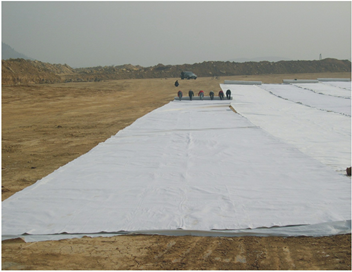
Modern infrastructure relies on robust separation and drainage boundaries. The unique physical properties of extruded polyester make it indispensable across several major heavy civil applications.
Engineers consistently use this material as a heavy-duty railway fabric. Dynamic, high-impact train loads create severe cyclical stress deep in the ground. This repetitive stress causes "pumping." Pumping happens when fine mud forces its way up into the clean stone ballast. Muddy ballast loses its load-bearing capacity rapidly. Tracks begin to settle unevenly. A strong, high-modulus separation layer prevents this destructive mixing. It keeps the ballast clean and functional. The track geometry remains stable under heavy freight traffic. Transit authorities stretch their maintenance cycles further apart, saving millions in routine re-ballasting costs.
Deep trench drains require uninterrupted, high-volume water collection. We rely on a highly stable filtration geotextile to wrap perforated collection pipes entirely. It allows high water flow while keeping the surrounding native soil out of the drainage stone. Soil ingress ruins French drains quickly. Silt fills the voids between the stones, destroying the system's hydraulic capacity. Continuous filament fabrics guarantee long-term performance in these deep burials. They conform tightly to trench walls. Their multi-directional strength prevents tearing during the aggressive backfilling of heavy drainage rock.
Hydrostatic pressure relief remains mandatory for vertical earth structures. Water must exit the backfill material as quickly as possible. If water stays trapped behind a wall, soil weight doubles or triples. Structural stability collapses under this immense added load. PET ensures rapid, reliable drainage without losing valuable structural fill. It guards against catastrophic wall failure. Installers place the fabric vertically between the native retained soil and the free-draining backfill aggregate. This simple separation layer acts as a permanent, fail-safe pressure relief valve.
Modern municipal solid waste landfills require thick, impermeable geomembranes. These critical plastic liners need robust protection from sharp rocks and debris. Our fabric acts as an engineered cushioning layer. It prevents catastrophic liner punctures during waste placement. Simultaneously, it facilitates aggressive leachate drainage above the liner. Environmental safety depends heavily on this dual protective function. The fabric must withstand extreme chemical and biological environments over a multi-decade operational lifespan. Its structural consistency provides environmental regulators with verifiable peace of mind.
Civil engineering requires precise material matching. Not all nonwoven fabrics perform equally under stress. Understanding the chemical and manufacturing differences helps you make informed procurement decisions.
We must look closely at polymer chemistry. Polypropylene (PP) offers excellent, broad-spectrum chemical resistance. However, Polyester (PET) provides significantly better resistance to physical creep. It maintains much higher tensile strength under sustained heavy loads. Civil engineers prefer PET for deep structural burials and massive highway embankments. You get superior dimensional stability. Still, you must evaluate PET geotextile carefully in highly alkaline soils. If local soil pH exceeds 9, PET can undergo hydrolysis and degrade over time. Review your geotechnical boring logs before final specification. For neutral to mildly acidic soils, PET dominates in long-term structural performance.
Manufacturing methods dictate final physical strength. Continuous filament structures use endless, extruded polymer threads. They lack any "loose ends." This endless structure makes them highly resistant to mechanical unravelling under stress. Staple fiber fabrics use short, chopped threads bonded together. Heavy dynamic loads can pull these short fibers apart. The continuous filament geotextile provides a much more uniform pore size distribution. Every square inch of the roll offers identical filtration capacity. You eliminate weak spots and thin patches common in lower-grade staple manufacturing. This uniformity is critical for precise hydraulic calculations.
Filtration requires a perfect physical balance. The fabric pores must be small enough to retain your specific site soil. Yet, they must remain large enough to allow continuous hydraulic flow. If pores are too large, valuable structural soil escapes. If they are too small, blinding occurs rapidly. Standardized laboratory testing measures this balance through Permittivity and Apparent Opening Size (AOS). Permittivity measures the volume of water passing through. AOS determines the largest soil particle passing through. Always match your fabric's AOS to the finest soil particles identified in your site survey.
Performance Feature | PET Continuous Filament | PP Staple (Short Fiber) |
|---|---|---|
Creep Resistance | Excellent under sustained heavy loads | Moderate; prone to stretching over time |
Puncture Strength | High; driven by endless bonded fibers | Lower; susceptible to fiber unravelling |
Alkaline Soil Tolerance | Moderate (Strictly recommended for pH < 9) | Excellent across extreme pH levels |
Pore Uniformity | Highly uniform filtration geometry | Variable; depends heavily on blending |
The best material in the world fails if installed poorly. On-site execution matters just as much as factory specifications. Mitigating common installation risks guarantees your drainage system meets its projected lifespan.
This fabric handles aggressive conditions remarkably well. Still, it requires graded, debris-free subgrades to maximize its lifespan. Large tree stumps, exposed rebar, or jagged boulders create severe pinpoint stress. Clear the installation area thoroughly before unrolling the material. Fill in deep ruts left by heavy equipment. Smooth out sudden grade changes. A uniform subgrade ensures the fabric bears tension evenly across its entire surface area. Point loading creates unnecessary vulnerability.
Proper overlapping prevents catastrophic soil migration at the panel joints. Standard engineering practices dictate specific overlap widths based on site conditions. Follow these general overlapping guidelines for safe installation:
CBR > 3: Use a minimum overlap of 300mm to 450mm.
CBR 1 to 3: Use a minimum overlap of 600mm to 900mm.
CBR < 1: Always sew the seams; do not rely on overlapping alone.
Softer soils require significantly wider overlaps. Soil movement during compaction can pull narrow overlaps apart easily. Sometimes, factory-grade sewing of the seams provides much better security than mere overlapping, especially in submerged conditions.
Direct sunlight breaks down synthetic polymers rapidly. Ultraviolet radiation degrades tensile strength within weeks. You must cover the fabric within a strictly specified timeframe. Manufacturers usually limit direct UV exposure to 14 to 30 days maximum. Plan your backfilling operations accordingly. Do not unroll acres of fabric if you cannot cover it quickly. Store unused rolls inside their opaque factory packaging. Delaying burial compromises long-term material integrity and voids manufacturer warranties.
Never run tracked machinery directly on exposed fabric. Heavy steel treads shred continuous fibers instantly. Rubber-tired equipment causes stretching and severe rutting. Always place a minimum of 150mm to 300mm of aggregate over the fabric before driving any heavy equipment over it. Direct operators to dump aggregate on previously placed stone, then push it forward carefully. This "end-dumping" best practice prevents catastrophic installation damage and preserves the filtration boundary.
Sourcing commercial-grade geotechnical materials requires extreme diligence. A cheap substitute will cost millions in delayed schedules and premature structural failures. Use these criteria to evaluate potential manufacturing partners.
Demand absolute proof of physical performance. Require suppliers to provide batch-specific technical data sheets. These documents must comply strictly with ASTM, AASHTO M288, or equivalent ISO testing standards. Generic marketing specification sheets are never enough. You need physical testing data for the exact rolls delivered to your site. Verify survivability classes according to AASHTO guidelines. Class 1 fabrics handle severe conditions, while Class 3 suits mild environments. Ensure your supplier understands and guarantees these precise distinctions.
Look for manufacturers running rigorous quality control programs. They should conduct in-house and third-party testing continuously. Key performance metrics include grab tensile strength, trapezoidal tear strength, and CBR puncture resistance. Ask potential suppliers for their detailed QA/QC manuals. Reliable manufacturers welcome technical audits. They gladly provide historical testing data showing consistent production tolerances. Transparency builds engineering trust. Opaque suppliers hide variable material blends and poor manufacturing controls.
Heavy civil construction sites generate massive material waste. Evaluate suppliers based on their ability to provide optimized, custom roll widths. Custom sizes drastically reduce on-site cutting. They also reduce the number of required seam overlaps across large areas. Fewer seams mean fewer potential points of failure underground. Wide rolls increase installation speed significantly. Your labor force spends less time unrolling and more time backfilling. Efficient sizing lowers your total installed project cost.
Specifying a heavy-duty continuous filament layer represents a mandatory upfront investment in risk mitigation. You prevent catastrophic, multi-million-dollar rework in the future. The exorbitant cost of excavating a failed retaining wall entirely dwarfs the initial material cost. Water constantly seeks out weaknesses in your design. Only highly engineered materials resist it permanently.
Project managers and civil designers should take immediate action. Match your site’s specific geotechnical soil report against the manufacturer's verified technical data sheets. Request physical product samples for independent lab verification. Confirm the chemical compatibility of your local soil. Rigorous upfront evaluation ensures your infrastructure delivers decades of reliable, uninterrupted subsurface drainage.
A: Woven geotextiles consist of precisely intersecting threads. They primarily provide soil reinforcement due to high tensile strength and low elongation, but offer lower water flow. Nonwoven continuous filament geotextiles consist of randomly bonded extruded fibers. They excel at filtration and long-term drainage, offering high water flow alongside balanced, multi-directional strength.
A: When installed correctly, it offers exceptional longevity. Evidence-based estimates show lifespans ranging from 50 to over 100 years in standard pH soils. You achieve these results by ensuring proper aggregate cover, avoiding direct track-laying damage, and preventing extended UV exposure before final burial.
A: You must exercise extreme caution in severe alkaline environments. PET can experience a destructive chemical process called hydrolysis if soil pH consistently exceeds 9. We recommend alternative polymers, like polypropylene, if your geotechnical report indicates highly alkaline conditions.
A: Material weight and thickness dictate physical durability. Higher mass per unit area increases puncture resistance and three-dimensional internal water flow capacity. However, the apparent opening size (AOS) determines actual filtration effectiveness. The AOS dictates exactly which soil particle sizes pass through and which remain trapped.


