

Views: 0 Author: Site Editor Publish Time: 2026-07-14 Origin: Site


Constructing heavy-duty pavements over weak, compressible subgrades introduces severe failure risks. Soft soils readily mix with expensive aggregate courses under dynamic traffic loads. This blending causes rapid rutting, surface cracking, and eventual structural collapse. Traditional remedies often require deep excavation. Contractors must dig out bad soil and replace it with massive volumes of crushed stone. These outdated methods demand massive budgets and lengthy project schedules.
You can solve these challenges by integrating a biaxial geogrid into your foundation design. This engineered polymeric structure acts as a rigid stabilization layer. It actively confines aggregate particles and distributes dynamic vehicle loads over a wider area. It fundamentally alters the mechanical performance of your granular base course.
This article provides project engineers, estimators, and contractors with a clear technical framework. We will explore how these materials work in the field. You will learn how to evaluate crucial specifications and source the exact geogrid required for reliable structural base stabilization.
Understanding how a geogrid interacts with soil requires looking beneath the surface. When heavy vehicles pass over a road, they exert immense downward pressure. This pressure forces unconfined crushed stone to shift and spread outward. Engineers call this lateral displacement. A properly installed geogrid physically stops this movement through specific mechanical interactions.
Mechanical interlock serves as the primary mechanism for stabilization. During construction, contractors place aggregate directly over the geogrid layer. As heavy rollers compact the stone, individual particles penetrate the open spaces of the grid. These open spaces are called apertures. The rigid ribs of the grid trap the angular stones tightly in place. This restricts the lateral mobility of the rock. The stone can no longer slide horizontally under heavy wheel loads. This interlocking action binds the loose aggregate and the geogrid into a single composite layer.
Vehicular traffic creates concentrated point loads. Without reinforcement, these vertical loads punch directly into the soft subgrade below. This causes localized shear failure and deep rutting. Geogrids mitigate this damage through the tension membrane effect. Because the aggregate remains locked within the grid, downward pressure creates tension across the polymeric ribs. The grid acts like a stiff trampoline. It catches the localized load and spreads it radially over a much wider area of the subgrade. Distributing the weight drastically reduces the stress applied to any single point of the underlying soil.
Confinement artificially increases the stiffness of the aggregate layer. When rock cannot spread sideways, it forms a denser, more rigid matrix. This confined base course acts as a protective shield for the soil below. It improves the overall bearing capacity of the pavement structure. This benefit proves especially vital when building over low CBR (California Bearing Ratio) soils. Soft clays and silts lack natural structural integrity. By confining the base aggregate, you prevent the heavy stone layer from sinking into the soft subgrade.
To visualize this stabilization process, consider these sequential steps:
Not all geogrids perform the same job. Manufacturers engineer different grid structures to solve distinct geotechnical problems. Choosing the wrong type of geogrid guarantees premature project failure. You must match the grid's tensile properties to the expected load directions.
Uniaxial geogrids offer high tensile strength primarily in one single direction. Manufacturers call this the machine direction (MD). During production, factories stretch the polymer sheet lengthwise to align the molecular structure. This creates exceptional pulling resistance along a single axis. Engineers specify uniaxial grids for grade separation projects. You will commonly find them reinforcing retaining walls, steepened slopes, and bridge abutments. In these applications, the primary stress forces pull outward in one predictable direction.
Pavements behave entirely differently than retaining walls. Roads, staging areas, and parking lots experience multi-directional dynamic loads. Vehicles brake, accelerate, and turn sharply. These actions generate complex, 360-degree shear forces within the aggregate base. You cannot stabilize a road effectively with strength in just one direction. Biaxial geogrids solve this problem. They provide roughly equal tensile strength in both the machine direction (MD) and the cross-machine direction (XMD). They absorb and distribute stress outward in a radial pattern.
Following a simple rule of thumb prevents costly specification errors. If your project involves stabilizing a flat plane subject to multi-directional loads, a base stabilization biaxial geogrid is the required technical choice. If you are building a vertical wall or reinforcing a steep embankment, utilize a uniaxial geogrid. Mixing up these applications will severely compromise structural safety.
Structural Comparison: Uniaxial vs. Biaxial Geogrids
| Feature | Uniaxial Geogrid | Biaxial Geogrid |
|---|---|---|
| Primary Strength Axis | Single direction (Machine Direction) | Both directions (MD and XMD) |
| Core Application | Retaining walls, steep slopes, embankments | Road bases, parking lots, foundations |
| Load Handling | Static, unidirectional pull forces | Dynamic, multi-directional traffic loads |
| Manufacturing Method | Punched and drawn longitudinally | Punched and drawn in two directions |
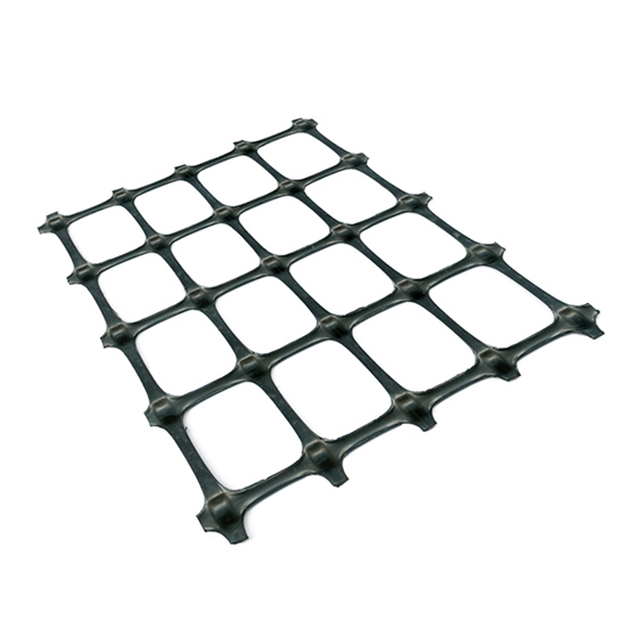
Looking at ultimate tensile strength alone rarely tells the whole story. A geogrid might possess massive ultimate strength but still fail to stabilize a road. The grid must physically integrate with the surrounding soil and stone. Engineers rely on comprehensive biaxial geogrid specifications to ensure materials meet rigorous field demands. You must evaluate the following metrics before approving submittal documents.
The open spaces between the grid ribs dictate project success. You must properly size these apertures relative to your chosen aggregate. If the apertures are too large, the stone simply pushes through without engaging the ribs. If the apertures are too small, the stone floats on top of the grid. Neither scenario provides mechanical interlock. Best practice dictates matching the aperture size to the D50 (average particle size) of your crushed stone base. The particles should comfortably drop into the holes and wedge tightly.
The points where the longitudinal and transverse ribs intersect are called junctions. These nodes endure tremendous abuse during compaction. Heavy vibratory rollers force sharp stones against these connections. Junction efficiency measures how much strength the node retains compared to the solid rib. You want a high junction efficiency to prevent the grid from tearing apart during installation. Furthermore, the grid must resist twisting. Torsional rigidity measures the grid's stiffness when subjected to rotational forces. A rigid grid maintains its aperture shape under heavy wheel loads, ensuring continuous aggregate confinement.
Ultimate tensile strength measures the force required to completely snap the material. However, roads fail long before a geogrid snaps. If a geogrid stretches 10 percent before providing resistance, your pavement will already show deep ruts. You must evaluate the tensile modulus at low strain levels. Engineers look closely at strength values at 2% and 5% strain. The grid must engage immediately. It must provide high resistance before significant deformation occurs within the pavement structure.
Manufacturers typically extrude geogrids from either Polypropylene (PP) or Polyester (PET). Polypropylene dominates the base stabilization market. PP offers exceptional flexural rigidity and high resistance to installation damage. It withstands the abrasive crushing forces of heavy angular stone. It also resists biological degradation and chemical attacks common in alkaline soils. Polyester grids often feature a protective PVC coating. They offer excellent creep resistance for long-term retaining wall projects but generally lack the rigid stiffness preferred for shallow aggregate confinement.
Common mistakes to avoid during specification review:
Integrating stabilization materials requires an upfront financial investment. However, the operational savings quickly offset the initial purchase price. Geogrids change the fundamental economics of earthwork construction. They allow contractors to build resilient structures using significantly fewer raw materials and fewer man-hours.
Crushed stone base material accounts for a massive portion of any paving budget. Geogrids artificially stiffen the aggregate layer. This increased efficiency allows you to safely reduce the required depth of the stone base. Proper application often yields a 20% to 40% reduction in required aggregate thickness. For example, a design requiring 15 inches of unreinforced stone might only need 9 inches of reinforced stone. This directly lowers your primary material purchasing costs while achieving the exact same structural capacity.
Reducing aggregate volume creates a chain reaction of logistical savings. Removing six inches of stone across a large parking lot eliminates hundreds of dump truck deliveries. Fewer truckloads mean drastically reduced hauling fees. You save money on diesel fuel and hourly trucking labor. Furthermore, removing heavy trucks from local highways minimizes community disruption. It also significantly lowers the carbon emissions associated with your project footprint.
Building over soft clay traditionally requires undercutting. Contractors must excavate the bad soil until they hit a firm subgrade. They then pay high tipping fees to dispose of the wet, unusable dirt offsite. Geogrids allow you to bridge over these weak soils. By placing a grid directly over the soft subgrade, you minimize the need for deep excavation. You eliminate the costly labor of digging. You also eliminate the expensive disposal fees associated with hauling away saturated clay.
The financial return extends far beyond the initial construction phase. Unreinforced pavements over weak soils deteriorate rapidly. The subgrade pumps up into the clean stone base, destroying its drainage capacity. Potholes form, and deep ruts emerge in the wheel paths. By confining the base, geogrids prevent this structural degradation. They maintain the integrity of the base course over decades. This delays the onset of surface cracking. It drastically reduces long-term maintenance costs and extends the overall lifecycle of the asphalt overlay.
Procuring the right material involves more than just finding the lowest price. A weak supply chain can derail an entire earthwork schedule. You must partner with vendors who provide verified engineering data and reliable logistical support.
Civil engineering demands strict accountability. You cannot install unverified polymers under critical infrastructure. Evaluate vendors based on their quality assurance and quality control protocols. Top suppliers maintain ISO 9001 certified manufacturing facilities. They submit their products to independent testing bodies like NTPEP (National Transportation Product Evaluation Program). A reputable biaxial geogrid supplier will readily provide standard technical data sheets. They will show publicly available ASTM testing data to verify every performance claim on their specification sheet.
Earthwork contractors operate on tight, weather-dependent schedules. You cannot afford to leave an excavated subgrade exposed to rain because your reinforcement materials are stuck in transit. Vendor inventory depth matters immensely. Discuss local warehousing capabilities with your supplier. Reliable shipping logistics prevent costly project delays. Ensure your vendor can deliver full truckloads to your job site precisely when the grading crew needs them.
Most manufacturers produce geogrids in standard roll widths, typically around 13 feet (4 meters). However, many projects feature unique dimensions. If you are constructing a narrow 15-foot access road, a standard roll creates massive overlapping waste. You end up paying for material you simply bury in the overlap zones. In these scenarios, sourcing a custom biaxial geogrid provides a major financial advantage. A supplier capable of slitting rolls or manufacturing custom widths helps you optimize coverage. Custom sizing minimizes waste, reduces cutting labor in the field, and speeds up the entire installation process.
Utilizing biaxial geogrid remains a proven engineering strategy for mitigating subgrade risks. These materials fundamentally improve how granular base layers perform under stress. They lock aggregate in place, distribute dynamic vehicle loads, and bridge over soft soils. By integrating these structures, contractors can build highly resilient pavements while drastically reducing their dependency on expensive crushed stone.
A: Yes, if the subgrade is highly saturated or contains fine-grained soils like clay or silt. The geotextile acts as a separator. It prevents the "pumping" of wet fines up into the clean crushed aggregate under heavy traffic loads. In this composite system, the geotextile provides critical separation, while the rigid geogrid provides the necessary structural reinforcement.
A: Overlap requirements depend entirely on the subgrade CBR (strength). Firm soils with a CBR greater than 3 typically require only 1 foot of overlap. However, very soft, yielding soils with a CBR less than 1 may require 2 to 3 feet of overlap. In extremely soft conditions, engineers may also require mechanical joining using industrial zip ties.
A: Generally, no. Biaxial geogrids are manufactured for granular base stabilization and earthwork applications. Asphalt reinforcement requires specifically coated fiberglass or highly specialized polymeric paving grids. Those specific materials are engineered to bond directly with bituminous tack coats and resist the extreme installation temperatures of hot mix asphalt.


